
If you’ve ever searched “Is LASIK safe?” “Am I too old for LASIK?” “What is better, LASIK or SMILE?” or even “What is the best eye surgery for me?”, you’re not alone.
Choosing vision correction can feel overwhelming. There are more options than ever—including LASIK, SMILE Pro, PRK, EVO ICL, refractive lens exchange (RLE), and advanced cataract surgery.
The good news? You don’t have to figure it out by yourself.
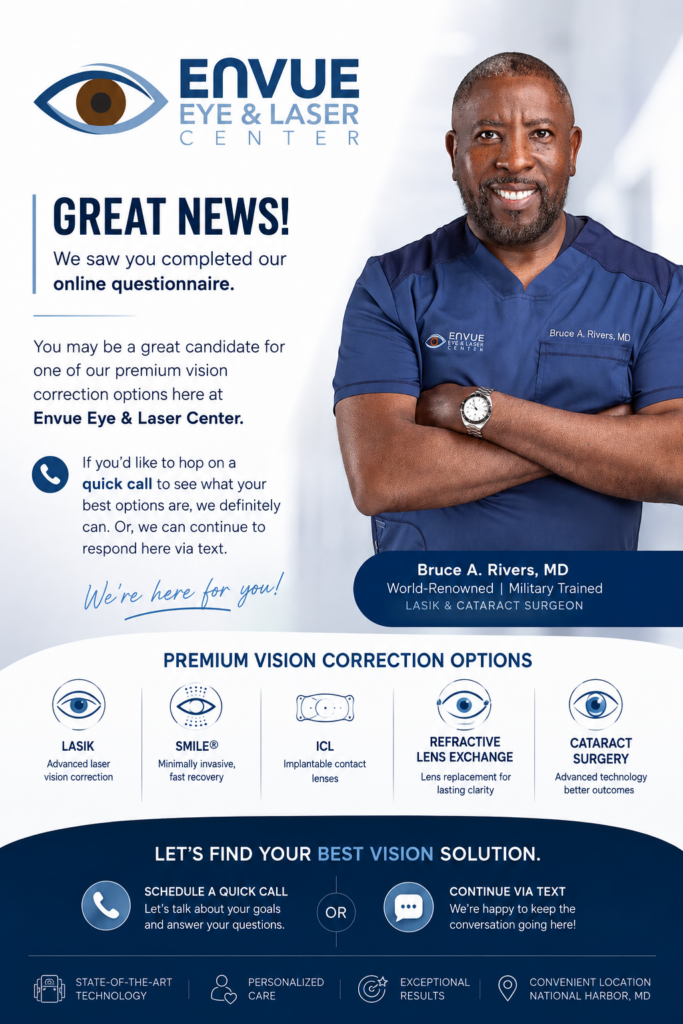
The right procedure depends on more than your glasses prescription. Your age, eye health, corneal anatomy, lifestyle, visual goals and even whether you need reading glasses can all affect which procedure makes sense for you.
At Envue Eye & Laser Center in the Washington, D.C. metro area, our philosophy is simple:
Vision correction isn’t one-size-fits-all.
Here are 25 of the most common questions patients ask before considering vision correction—and what you should know before making a decision.
1. Am I a candidate for laser eye surgery?
Possibly—but candidacy cannot be determined by your glasses prescription alone.
A comprehensive vision correction evaluation looks at your prescription, whether your vision has been stable, the health and shape of your cornea, your tear film and dry-eye status, and the overall health of your eyes.
Your age and visual goals also matter.
For example, someone in their 20s who is nearsighted may be an excellent candidate for SMILE Pro or LASIK, while someone in their late 40s who is beginning to need reading glasses may have better options to consider.
The FDA recommends that patients considering refractive surgery understand their individual risks and benefits and undergo appropriate evaluation before surgery.
Bottom line: The question isn’t simply “Can I get LASIK?” It’s “Which vision correction option is safest and most appropriate for my eyes?”
2. What is the best laser eye surgery?
There isn’t one procedure that is best for everyone.
Depending on your eyes and goals, your options may include:
- SMILE Pro
- LASIK
- PRK
- EVO ICL
- Refractive Lens Exchange (RLE)
- Cataract surgery with advanced lens implants
SMILE Pro, LASIK and PRK reshape the cornea to correct refractive error. EVO ICL uses an implantable lens, while RLE replaces the eye’s natural lens with an artificial intraocular lens.
The best choice is the procedure that matches your anatomy, prescription, age, lifestyle and visual goals.
3. Is SMILE Pro better than LASIK?
SMILE Pro may be a better fit for some patients, while LASIK may be preferable for others.
SMILE Pro is a flapless form of laser vision correction. Instead of creating a LASIK flap, the procedure uses a femtosecond laser to create a small lenticule within the cornea, which is removed through a small incision.
The FDA has approved SMILE using the VisuMax platform for the reduction or elimination of myopia with or without astigmatism within specified ranges and in patients meeting the required candidacy criteria.
At Envue, we often discuss SMILE Pro with patients who are interested in a flapless procedure, including active patients and athletes.
4. Is SMILE Pro safer than LASIK?
Both procedures have established safety and effectiveness when appropriately performed in properly selected patients.
The important question is not simply which procedure has the better marketing message. It is which procedure is appropriate for your individual eyes.
The FDA emphasizes that risks and benefits can vary by procedure, technology and surgeon experience, and recommends comparing those factors rather than making a decision based solely on cost.
SMILE Pro’s flapless approach can be appealing to some patients, particularly those concerned about a LASIK flap or who participate in active lifestyles.
5. Does laser eye surgery hurt?
Most patients describe the procedure itself as unusual rather than painful.
Numbing eye drops are used before surgery. You may experience gentle pressure during the procedure.
Afterward, your experience depends on the procedure. PRK generally involves a longer and more uncomfortable recovery than LASIK or SMILE Pro.
Your surgeon should explain what you can realistically expect before surgery—including both the benefits and potential side effects.
6. How quickly will I see after SMILE Pro or LASIK?
Many patients notice improved vision very quickly after laser vision correction, but early vision is not necessarily the same as final stabilized vision.
Recovery varies from person to person and depends on the procedure, prescription, eye health and individual healing response.
At Envue, your postoperative visits are designed to monitor your healing and visual recovery rather than simply assuming that everyone follows the same timeline.
7. How long does laser eye surgery recovery take?
Recovery depends on the procedure.
Generally:
SMILE Pro and LASIK: Vision can improve rapidly, with many patients returning to normal activities relatively quickly.
PRK: The surface of the cornea must heal, so visual recovery generally takes longer.
Your surgeon will give you specific instructions regarding driving, exercise, swimming, eye makeup, contact sports and other activities.
8. Can laser eye surgery correct astigmatism?
Yes—depending on the procedure and your individual prescription.
SMILE is FDA-approved for myopia with astigmatism within specified parameters, and LASIK and PRK can also treat many patients with astigmatism.
Astigmatism does not automatically mean you are disqualified from vision correction.
The important question is whether your specific prescription and corneal anatomy are appropriate for the procedure being considered.
9. How long does laser vision correction last?
The corneal correction created by laser vision correction is intended to be permanent.
However, your eyes continue to age.
That distinction is important.
Laser vision correction can correct your existing refractive error, but it does not stop natural age-related changes such as presbyopia.
That’s why someone can have excellent distance vision after LASIK, PRK, SMILE Pro or EVO ICL and still eventually need reading glasses.
10. Will I need glasses again after LASIK or SMILE Pro?
Possibly.
If you are younger and do not yet have presbyopia, you may enjoy years of reduced dependence on glasses or contacts.
But eventually, most people experience presbyopia—the age-related loss of the eye’s ability to focus up close.
This is one reason that vision correction for a 25-year-old is a very different conversation from vision correction for a 48-year-old.
LASIK After 40: The Questions You Should Be Asking
11. Can I get LASIK if I’m over 40?
Yes, some people over 40 are candidates for LASIK.
But there’s an important consideration: presbyopia.
Beginning in the 40s, the natural lens of the eye gradually loses its ability to focus on nearby objects. This is why many people who have never needed reading glasses suddenly find themselves holding their phone farther away.
Presbyopia is a normal age-related change and should be part of every vision correction discussion for patients around or over 40.
12. Why do I still need reading glasses after LASIK?
Because LASIK corrects the focusing power of the eye for distance, but it does not stop the natural aging of the eye’s lens. This is also known as the early stages of dysfunctional lens syndrome.
If you’re already experiencing presbyopia, conventional LASIK may give you excellent distance vision while leaving you dependent on reading glasses.
That’s why patients in their 40s and 50s should discuss all available vision correction options—not just LASIK.
13. Is LASIK or RLE better after 45?
There isn’t one right answer.
For some patients in their mid-to-late 40s and beyond, refractive lens exchange (RLE) may be worth considering because it replaces the natural lens rather than reshaping the cornea.
RLE may be an option for patients who:
- Are in their 40s or 50s and are becoming dependent on reading glasses
- Are farsighted
- Have prescriptions that may not be ideal for laser vision correction
- Want to reduce dependence on glasses at multiple distances
- Have been told they aren’t candidates for LASIK or another corneal procedure
At Envue, RLE is evaluated individually because lens-based surgery is not appropriate for everyone.
What If LASIK Isn’t Your Best Option?
14. Can I get LASIK with a high prescription?
It depends on your prescription and the health and anatomy of your eyes.
Some patients with higher prescriptions may qualify for laser vision correction. Others may be better candidates for an implantable lens such as EVO ICL.
This is one of the reasons a comprehensive evaluation is so important.
15. What if I’m not a candidate for LASIK?
Don’t assume that means you’re out of options.
Depending on your eyes, alternatives may include:
- SMILE Pro
- PRK
- EVO ICL
- RLE
- Other lens-based options
- No treatment
The FDA notes that alternatives to LASIK can include other refractive procedures and lens-based approaches.
At Envue, the goal isn’t to fit every patient into the same procedure.
The goal is to find the right procedure for the patient.
16. What is EVO ICL?
EVO ICL is an implantable lens designed to correct refractive error without removing corneal tissue.
It may be considered for certain patients who are not ideal candidates for corneal laser procedures or who have prescriptions and anatomical characteristics better suited to an implantable lens.
Whether EVO ICL is appropriate depends on a detailed eye evaluation.
Questions About Contacts, Dry Eye & Everyday Life
17. Can I get LASIK or SMILE Pro if I have dry eyes?
Dry eye is an important part of the preoperative evaluation.
Patients with significant dry eye may need treatment before undergoing refractive surgery.
At Envue, ocular surface health is evaluated as part of the vision correction process because healthy eyes are the foundation for good visual outcomes.
If you have dry-eye symptoms, tell your surgeon before surgery.
18. Do I have to stop wearing contacts before vision correction?
Yes. Contact lenses can temporarily change the shape of the cornea, which can affect the accuracy of your measurements.
The amount of time you need to discontinue contact lens wear depends on the type of lenses you use and your individual situation.
Your surgical team will tell you exactly when to stop wearing them before your evaluation and procedure.
19. Can I have SMILE Pro if I play sports?
Potentially.
One reason active patients may be interested in SMILE Pro is that it is performed without creating a traditional LASIK flap.
At Envue, we’ve worked with athletes—including Howard University basketball players—and frequently discuss flapless vision correction with patients whose lifestyles involve sports and physical activity.
What Can I Do After Vision Correction?
20. When can I exercise after LASIK or SMILE Pro?
Your return to exercise depends on the procedure and your surgeon’s postoperative instructions.
Light activity may resume relatively quickly for many patients, while activities that increase the risk of eye trauma or contamination may require additional precautions.
Your surgeon should give you specific instructions based on your procedure and lifestyle.
21. When can I swim after vision correction?
Swimming is generally restricted during the early healing period because pools, hot tubs and natural bodies of water can expose healing eyes to microorganisms and irritants.
Follow your surgeon’s specific timeline.
22. When can I play contact sports?
This depends on the procedure.
Because sports can involve direct trauma to the eye, your surgeon may recommend additional precautions or a longer waiting period before returning to contact sports.
This is another reason your lifestyle should be part of the procedure-selection conversation—not an afterthought.
23. Can I travel after laser eye surgery?
Many patients travel soon after uncomplicated vision correction, but timing depends on the procedure, your healing and your postoperative care plan.
If you’re planning a trip, tell your surgeon before scheduling surgery.
You may need to coordinate postoperative visits and make sure you have access to appropriate care if an issue arises.
The Question That Matters Most
24. How much does laser eye surgery cost in Washington, D.C.?
Price is an important consideration—but it shouldn’t be the only one.
At Envue, we believe in clear and transparent pricing. Patients should know the price upfront.
Envue Vision Correction Pricing
SMILE Pro: $2,500 per eye
LASIK: $2,500 per eye
PRK: $2,500 per eye
EVO ICL: $4,500 per eye
RLE: $6,000 per eye
Our laser vision correction procedures—LASIK, SMILE Pro and PRK—are priced the same so that patients can focus on choosing the procedure that’s best for their eyes rather than choosing based on price. Envue also offers financing options.
Insurance typically does not cover elective laser vision correction, although patients should check their individual benefits and available FSA/HSA options.
So Which Vision Correction Procedure Is Right for You?
There is no universal answer.
But this is a helpful starting point:
| If you are… | Procedures you may want to discuss |
|---|---|
| Nearsighted and interested in laser vision correction | SMILE Pro, LASIK, PRK, or EVO ICL |
| Nearsighted with astigmatism | SMILE Pro, LASIK, PRK, or EVO ICL |
| An athlete or highly active | SMILE Pro, LASIK, PRK, or EVO ICL, depending on your evaluation |
| Concerned about a LASIK flap | SMILE Pro may be worth discussing |
| Have a high prescription | SMILE Pro, LASIK, PRK, EVO ICL, or RLE |
| Over 40 and increasingly dependent on reading glasses | RLE or other age-appropriate options |
| Farsighted | LASIK, RLE or other options depending on age and anatomy |
| Have early cataract changes | Cataract surgery with an appropriate IOL |
| Told you’re not a LASIK candidate | Ask about SMILE Pro, PRK, EVO ICL, RLE or other alternatives |
Important: This table is a starting point.
Why Patients Choose Envue
At Envue Eye & Laser Center, we don’t believe in putting every patient into the same procedure.
Our approach is built around personalized vision correction.
Located at National Harbor in Oxon Hill, Maryland, Envue serves patients throughout Washington, D.C., Maryland and Northern Virginia. The practice offers SMILE Pro, LASIK, PRK, EVO ICL, RLE and laser-assisted cataract surgery.
Envue is also the only practice in the Washington, D.C. metro area currently offering ZEISS SMILE Pro. Dr. Bruce Rivers is a military-trained refractive surgeon who previously directed the Warfighter Refractive Eye Surgery Program and Research Center at Fort Belvoir.
Most importantly, the goal is to determine which procedure—if any—is right for you.
Ready to Find Out Which Option Is Right for You?
You’ve researched LASIK.
You’ve read about SMILE Pro.
You’ve compared PRK, EVO ICL and RLE.
Now it’s time to find out what makes sense for your eyes.
At Envue, your vision correction consultation includes a comprehensive diagnostic evaluation and a personalized discussion of your visual goals, lifestyle and treatment options.
Book Your Free Vision Correction Consultation
SMILE Pro. LASIK. PRK. EVO ICL. RLE. Cataract surgery.
More options. One personalized vision plan.
Envue Eye & Laser Center
National Harbor | Oxon Hill, Maryland
Serving Washington, D.C., Maryland & Northern Virginia
Call or text: 301-485-9533
Medical Disclaimer: This article is for educational purposes only and is not a substitute for an examination or individualized medical advice. Vision correction candidacy and procedure selection vary from patient to patient. A comprehensive evaluation with a qualified ophthalmologist is necessary to determine whether a procedure is appropriate for you.
Content reviewed by Dr. Bruce Rivers, Medical Director, Envue Eye & Laser Center.